
Why Every Luxury Villa Should Have an Ice Bath
Cold plunge installations are moving from performance labs into premium villas across Bali. Here's the science, the economics, and what discerning guests now expect.
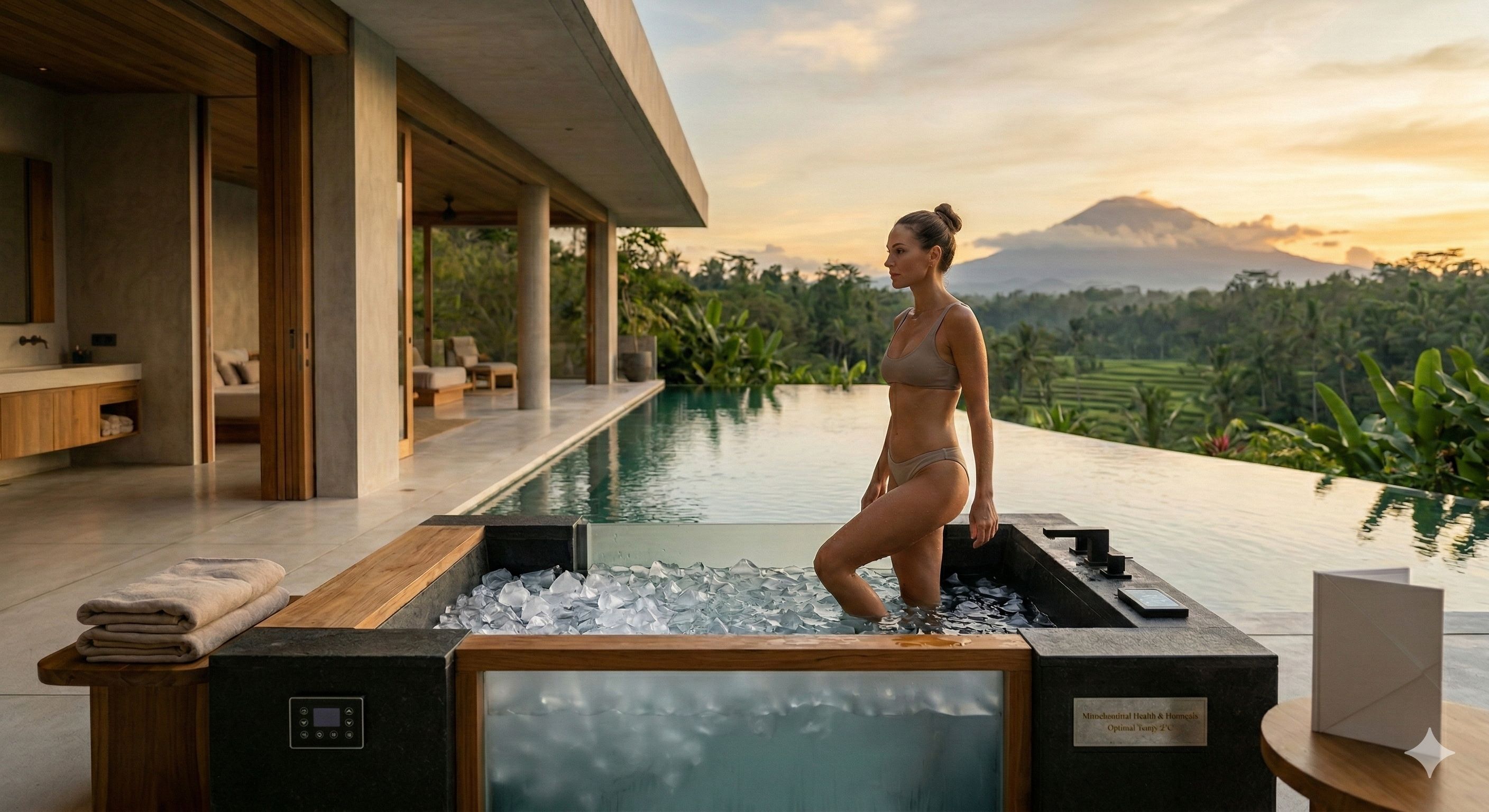
Five years ago, a cold plunge at a Bali villa was a novelty. Today, guests who train seriously — competitive athletes, biohackers, remote professionals running structured fitness programs — list cold exposure infrastructure alongside fast Wi-Fi and a proper squat rack as non-negotiables. The shift happened fast, and it isn't reversing.
The Demand Shift Is Real
Bali's villa market has historically competed on aesthetics: infinity pools, rice terrace views, hand-carved stone. That still matters. But a new segment of traveler — younger, higher-earning, deeply invested in their physical output — is routing booking decisions around recovery infrastructure. When a CrossFit coach from Sydney or a triathlete from Amsterdam is choosing between two comparably priced villas in Canggu, the one with a cold plunge wins. It's that binary.
Platform data from properties that have installed cold plunges in the last 18 months shows consistent occupancy lifts of 15–22% within the target demographic, alongside measurably higher average booking values. Guests who prioritize recovery facilities also tend to book longer stays — they're building training camps, not holiday weekends.
The Science Behind Cold Exposure
The physiological case for deliberate cold exposure is no longer fringe. Dr. Andrew Huberman's work at Stanford on the catecholamine response to cold has brought the mechanism into mainstream awareness: water-based cold exposure at 10–15°C triggers a significant release of dopamine, norepinephrine, and epinephrine. The norepinephrine spike — up to 300% above baseline in studies using 14°C water for 60 seconds — persists for several hours post-exposure, supporting focus, mood, and metabolic rate.
For athletic recovery specifically, the evidence is more nuanced. Meta-analyses published in the British Journal of Sports Medicine consistently show cold water immersion (CWI) reduces perceived soreness, accelerates subjective recovery, and maintains subsequent performance output better than passive rest — particularly relevant for guests training daily across a multi-week stay.
What Cold Exposure Actually Does to Your Body
- Norepinephrine surge of 200–300% supports sustained focus and energy for 2–4 hours post-session
- Vasoconstriction followed by vasodilation (the 'vascular pump') accelerates metabolic waste clearance from muscle tissue
- Reduced inflammatory cytokine activity in the 24 hours following intense training
- Improved deep sleep quality reported by regular cold exposure practitioners — relevant for travel recovery
- Dopamine release profile is gradual and sustained, unlike the sharp spike from stimulants
- Cold-induced brown adipose tissue activation increases non-shivering thermogenesis over time
- Mental resilience adaptation: deliberate discomfort tolerance transfers across domains
Cold Plunge Protocols: Where to Start
Not all cold exposure is equal. Temperature, duration, and timing relative to training all affect outcomes. The following protocols are calibrated for villa guests — healthy adults without contraindications, operating in Bali's ambient heat, looking to optimize recovery and cognitive performance.
Beginner
Temperature: 15°C (59°F)
Duration: 60–90 seconds
Enter slowly. Focus on controlled nasal breathing — do not hyperventilate. Stay still; movement accelerates heat loss faster than most beginners can manage. Exit when you can no longer maintain calm breathing. One session per day maximum. Best performed in the morning on an empty stomach for the cleanest dopamine response.
Intermediate
Temperature: 11–13°C (52–55°F)
Duration: 2–4 minutes
Aim for total weekly cold exposure of 11–15 minutes, distributed across multiple sessions. Post-training use (60–90 min after lifting) is effective for soreness; morning use optimizes the alertness and mood response. Avoid cold immersion immediately post-strength training if hypertrophy is the priority — it can blunt anabolic signaling.
Advanced
Temperature: 8–10°C (46–50°F)
Duration: 4–6 minutes
At sub-10°C, sessions beyond 6 minutes offer diminishing returns and increasing hypothermia risk. Use contrast cycling (alternating with sauna or hot shower) to extend total session time safely. Protocols from elite sports science programs suggest a 1:3 ratio — 2 minutes cold to 6 minutes heat — repeated 3–4 rounds for maximum vasodilation benefit.
What a Professional Cold Plunge Costs to Install
Villa operators considering an installation should understand the tiered economics. Entry-level stock tank or fiberglass plunge pool setups with a basic chiller unit run USD $3,000–$6,000 installed — adequate for temperatures down to around 10°C in Bali's climate. Mid-tier dedicated cold plunge units (Renu Therapy, Ice Barrel Pro, equivalent brands available through Bali fitness distributors) with precise thermostat control run $8,000–$15,000. High-end recirculating systems with UV filtration, ozone sanitation, and smart temperature control — the type that serious operators should consider for guest-facing installation — run $18,000–$35,000 USD installed, including ongoing sanitation infrastructure.
Ongoing operational costs are modest: electricity for continuous chilling in Bali's climate runs approximately $80–$140 USD/month for a quality unit. Sanitation chemicals and filter maintenance add another $30–$60/month. Compared to pool maintenance, the numbers are favorable. The real ROI is in booking differentiation.
Temperature accuracy matters more than aesthetics. A cold plunge that holds a reliable 10°C is worth more to a serious guest than one that looks stunning but cycles between 12°C and 18°C. Ask the villa operator what temperature their unit is calibrated to and whether it has active chilling or relies on ice. Active chilling units are the standard for any serious installation.
What Guests Should Look for When Booking
Not every listing that mentions 'ice bath' or 'cold plunge' delivers the same experience. Here's how to evaluate before you book. First, confirm the temperature range — a real cold plunge operates at 8–15°C. Anything above 15°C is cool water, not cold exposure. Second, ask about the chilling system: stock tanks with manually added ice are inconsistent and labor-intensive; dedicated chiller units are preferable. Third, check the sanitation protocol — shared cold plunge tubs without proper filtration are a hygiene concern. UV and ozone systems are the current standard. Finally, consider placement: outdoor plunge pools in direct Bali sun will struggle to hold temperature by midday.
The Broader Wellness Stack
Cold exposure is rarely used in isolation by serious practitioners. The optimal villa setup pairs the cold plunge with a sauna or steam room for contrast therapy, a space for breathwork (Wim Hof, box breathing, CO2 tolerance tables), and ideally proximity to outdoor training. Properties that have invested in this full stack — cold, heat, breath, movement — are capturing an increasingly valuable guest profile that books longer, reviews better, and returns at higher rates than leisure-only travelers.
More from the Journal
The Complete Canggu Fitness Guide
Canggu has quietly become Southeast Asia's most serious fitness destination. This is where to train, eat, run, and recover across Berawa, Batu Bolong, and Echo Beach.
Feb 9, 2026 · 9 min read
IndustryThe Rise of Wellness Tourism in Bali
Bali's tourism identity is shifting from party destination to performance hub. Here's why wellness travel is growing at 20%+ annually and what it means for how villas are being built.
Jan 27, 2026 · 7 min read
WellnessContrast Therapy: The Complete Recovery Protocol
Sauna and cold plunge contrast therapy is the most evidence-backed active recovery tool available. Here is the exact protocol, the mechanism, and how to implement it across a training week.
Jan 14, 2026 · 10 min read